

VISITING HOURS:
Week Days - 9 am to 8 pmSundays - Only Emergency Cases
Can You Get Invisalign If You Have Crowns or Fillings?
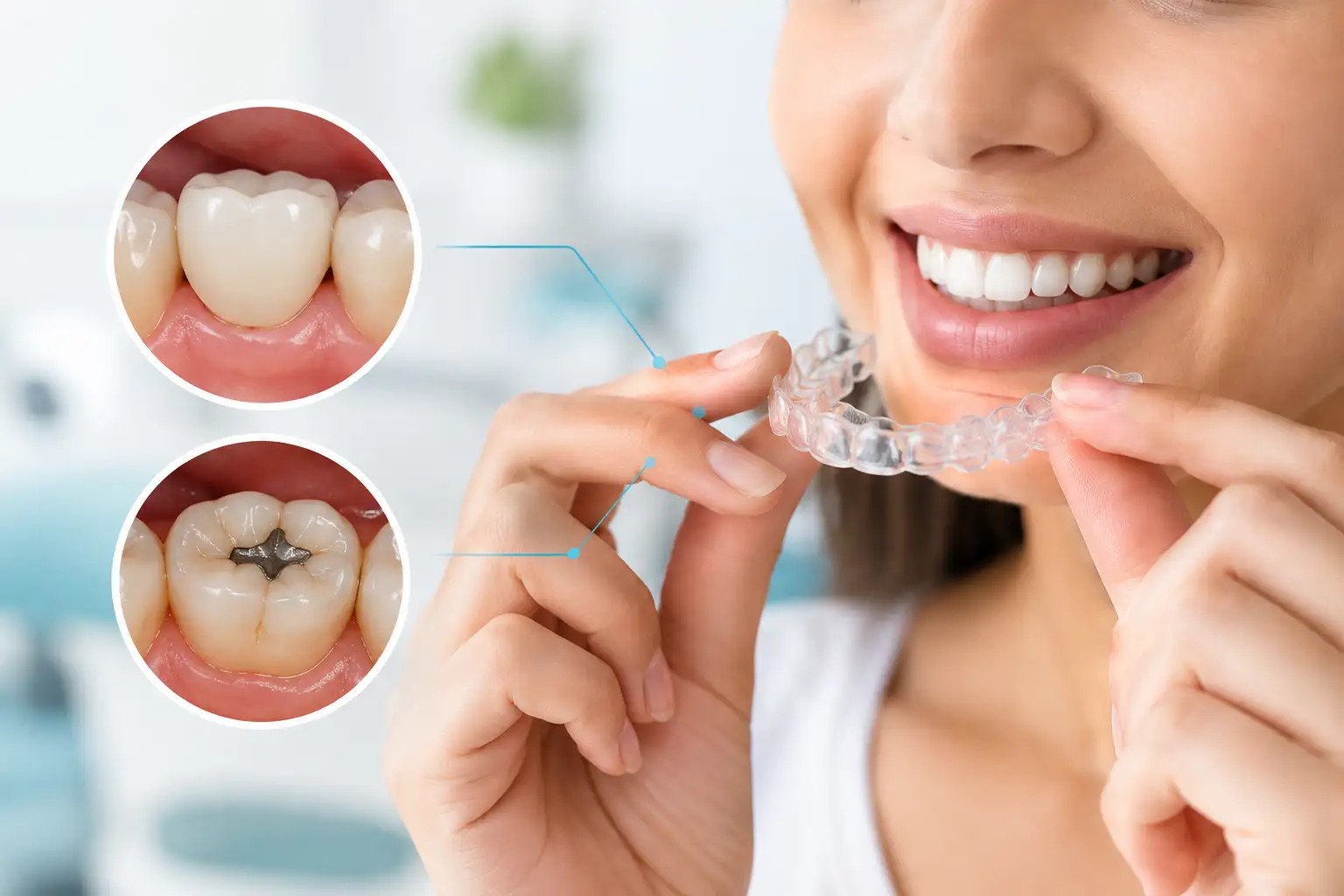
Having crowns or fillings does not mean you cannot have Invisalign. Many people start treatment with existing dental work, and in many cases, their crowns and fillings can remain in place. What matters is the condition of the tooth and the restoration, as well as how the dental work may affect tooth movement.
Before starting treatments, your dentist will check your teeth, crowns, fillings, and gums. They will also look at whether any restoration could affect how a tooth moves or where an Invisalign attachment can be placed. In this blog, we look at how Invisalign works with crowns and fillings and when existing dental work may need attention.
How Invisalign Moves Teeth
Invisalign uses a series of clear aligners to gradually move your teeth. You wear one set at a time and change to the next as your treatment progresses. Each aligner puts gentle pressure on the teeth to move them in the direction your dentist has planned. Small tooth-coloured attachments may also be added to some teeth when extra grip is needed.
As a tooth moves, the bone around its root also changes to allow the tooth to move. This means a tooth with a crown or filling can still move with the aligner. The crown or filling stays attached to the tooth rather than moving separately.
Your dentist will check any crowns or fillings before treatment begins. They will look at their condition and position and consider whether they could affect the movement of the tooth. They will also check whether an attachment can be placed securely on the tooth or restoration.
Also Read: Can Invisalign Improve Facial Symmetry?
Invisalign With Dental Crowns
A crown covers the visible part of a damaged or weakened tooth, while the natural root remains in the jaw. Because the natural tooth is still there, a crowned tooth can usually be moved with Invisalign. One thing your dentist will consider is where the Invisalign attachment can be placed. Depending on the tooth and the movement needed, an attachment may be placed on the crown. If that is not suitable, it may be placed on a nearby natural tooth instead. In some cases, the crowned tooth can also be moved without an attachment.
The condition of the crown also matters. If it is damaged, does not fit properly, or there is decay around the edge, these problems should be treated before Invisalign treatment starts. This helps avoid moving a tooth that needs dental work first.
Invisalign With Dental Fillings
A filling replaces only part of the tooth, so the natural tooth can still move with Invisalign. Having a filling does not usually prevent you from having clear aligner treatment. If an attachment is needed, your dentist will decide where it should be placed based on the tooth and the movement required. It may be possible to place it on the filled tooth, or a nearby natural tooth may be a better option.
The filling and the tooth around it should also be checked before treatment. Your dentist will look for cracks, chips, gaps around the filling, or signs of decay. If the filling needs to be repaired or there is untreated decay, it is better to deal with these problems before starting Invisalign.
Do Crowns or Fillings Need to Be Replaced First?
Starting Invisalign does not require you to replace your crowns or fillings. If your existing dental work is healthy and secure, it can usually stay in place during treatment. What matters is the condition of the restoration and the tooth underneath it. If either one has a problem, your dentist may need to treat it before you start Invisalign. A loose or damaged crown, a cracked or leaking filling, or decay around the restoration requires attention first. The same applies if the restoration shape or position makes it difficult to place an Invisalign attachment.
Your dentist will check all of this before putting in aligners. If your existing dental work is stable and the teeth underneath are healthy, there may be no reason to change anything. If a crown or filling needs attention, it is better to deal with it before Invisalign treatment begins. This gives your dentist a healthy and stable starting point for planning your aligners.
What Happens If You Need a New Crown or Filling During Treatment?
Dental needs can arise at any time, but that is no reason to stop treatment. The approach depends on what is needed. A small filling can often be completed mid-treatment, where the aligners can be adjusted or refitted afterwards if required. Because your teeth are gradually moving, a permanent crown made for a tooth in its starting position may not suit it once it has shifted.
In many cases, the dentist places a temporary crown and waits until the tooth reaches its planned position before fitting the permanent one. If the permanent crown is already in place, the dentist can take a digital scan and plan the remaining aligners around the existing crown. If you notice sensitivity, a loose crown, or a cracked filling while wearing aligners, contact your dentist promptly instead of waiting for your next scheduled visit.
What Your Dentist Evaluates Before Starting Invisalign
Before starting Invisalign, your dentist will check your teeth, gums, bite, and existing dental work. This helps identify any problems that may need to be treated before your aligners are made and also gives your dentist a clear idea of how your teeth need to move:
- A full examination of teeth, gums and bite
- X-rays to check roots, bone levels and hidden decay
- A review of the age, material and condition of every crown and filling
- An assessment of any teeth that have had root canal treatment
- A check of gum health, since inflamed or receding gums should be treated first
- A discussion of your goals and how complex the movements will be
- Digital scans to map out the sequence of tooth movement
Also Read: The Role of 3D Scanning in Invisalign Treatment
Invisalign With Existing Crowns and Fillings
Having crowns or tooth fillings does not mean you have to avoid Invisalign. If your dental work is in good condition, it may not require any changes before you start treatment. Your dentist will check your existing restorations when planning how your teeth should move. They will also consider whether a crown or filling could affect the placement or bonding of Invisalign attachments.
If you are looking for a dental clinic in Kochi, an Invisalign consultation can help you understand how your crowns and fillings may affect your treatment. Dentique offers Invisalign in Kochi and can assess your teeth and existing dental work to determine whether clear aligners are suitable for you. Have crowns or fillings, and are you considering Invisalign? Contact Dentique to schedule a consultation and discuss the right treatment approach for your smile.
OUR
TREATMENTS
TREATMENTS

6ab6604bb7d17.webp)









6aba331adb684.webp)