

VISITING HOURS:
Week Days - 9 am to 8 pmSundays - Only Emergency Cases
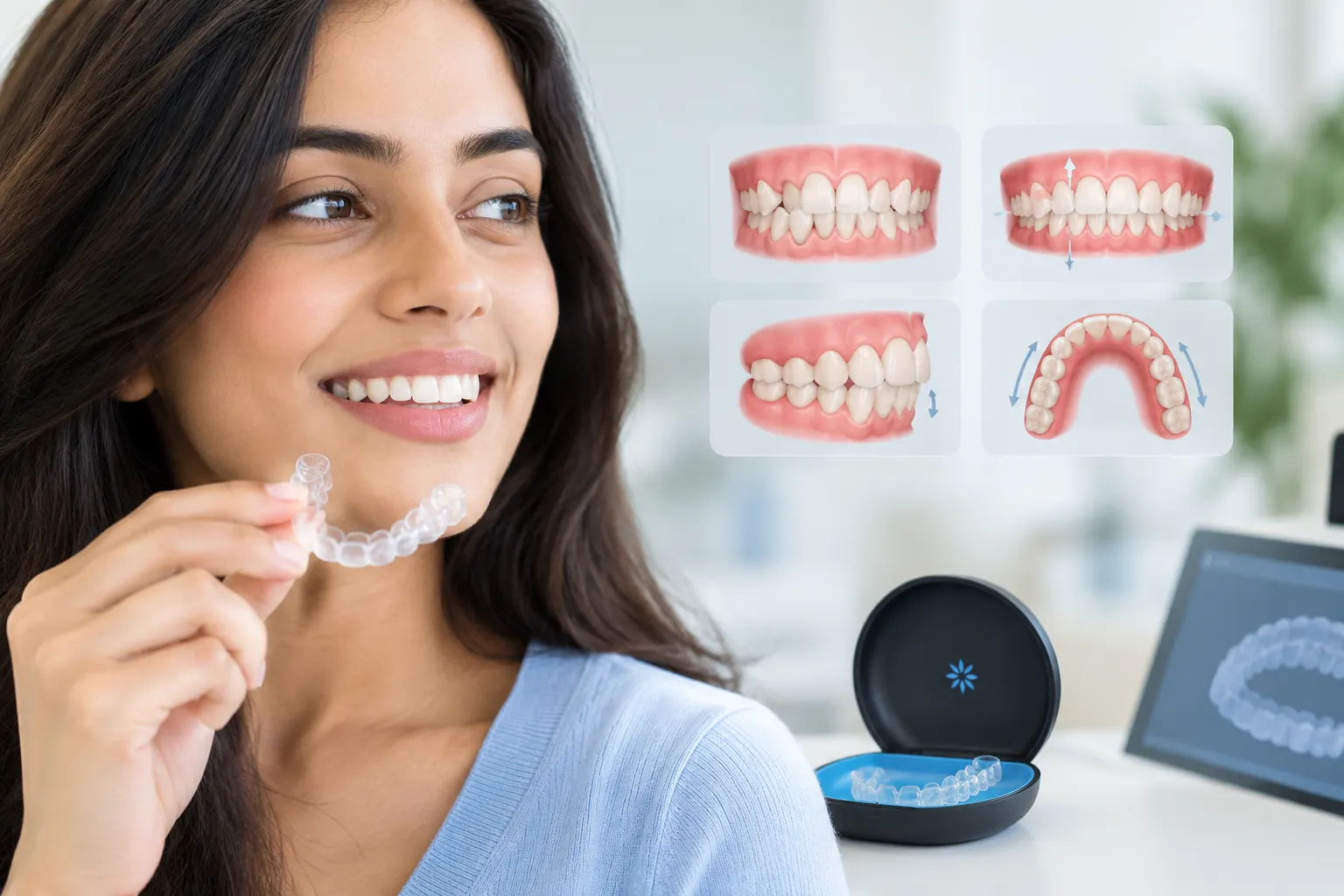
How Invisalign Handles Complex Tooth Movements
Straightening teeth is not a simple process. Most people who consider clear aligner treatment are dealing with more than one issue at once. These include dental crowding, dental spacing, tooth rotation, and malocclusion. Invisalign is often used to address these orthodontic concerns as part of a carefully planned treatment. Each case is assessed individually to determine the most suitable approach.
Rather than depending on a single treatment method to do all the work at once, Invisalign uses a series of custom-made clear aligners, with each aligner moving the teeth in small, planned increments until the final position is reached. Understanding how this process works helps explain why Invisalign has become a trusted option for patients with more involved orthodontic needs.
Understanding the Nature of Complex Movements
The difficulty of tooth movement varies case to case. Mild spacing or minor crowding tends to respond well within a short sequence of aligners. Rotations, on the other hand, are difficult to manage, particularly on premolars, where the rounded tooth surface gives the aligner less to grip than teeth that have more angular surfaces. Bite-related concerns add further complexity. An open bite, deep bite, or crossbite requires the upper and lower arches to move together rather than being corrected as two separate problems.
Also Read: Can Invisalign Correct Overbite, Underbite & Crossbite?
The Invisalign aligner series is built around this variation. At each stage, certain teeth act as stable anchor points while the aligner directs controlled pressure toward the teeth that actually need to shift. As each aligner in the sequence builds on the movement achieved by the one before it, treatment can achieve results that would be difficult to manage in a single step when rotation or bite correction is needed with general alignment.
Role of Digital Treatment Planning in Invisalign
Every Invisalign case begins with detailed digital scanning of the patient's teeth and bite. This scan creates a three-dimensional model that maps out how each tooth will move from its current position to its final one. Because this planning happens digitally before any aligners are manufactured, the dentist can preview the entire treatment journey, adjust the sequence of movements, and identify which stages will require additional support.
Also Read: The Role of 3D Scanning in Invisalign Treatment
This planning is particularly valuable for complex cases. A tooth that needs to rotate forty-five degrees, for instance, cannot be moved in one step. The digital plan breaks that rotation into a sequence of smaller, achievable movements distributed across multiple aligners so that the movement stays within a range the tooth and surrounding bone can safely tolerate. The same principle applies to bite corrections, where upper and lower teeth must be guided into a coordinated final relationship rather than moved independently.
Attachments and Their Function in Difficult Movements
For many complex cases, aligners cannot create the force needed for controlled movement. This is where attachments come in. These are small, tooth-coloured shapes bonded temporarily to specific teeth, giving the aligner additional points of contact to grip onto. Attachments help the aligner to exert more precise pressure in a particular direction, which is especially useful for rotations, extrusions, and movements that require a tooth to tip or shift along a specific axis.
Attachments are placed strategically based on the digital treatment plan, and their shape and position are chosen according to the specific movement required at that stage. As treatment advances and certain movements are completed, attachments may be adjusted, removed, or added elsewhere on the arch to support the next set of movements in the sequence.
Staged Treatment for More Involved Cases
A single continuous set of aligners rarely resolves a complex orthodontic case. Treatment is usually broken into stages, and progress is reviewed at set intervals so the dentist can confirm that teeth are tracking as planned before the next phase begins. If a tooth fails to respond as anticipated, the dentist has options, such as refinement aligners, extra attachments, or a revised digital plan, any of which can be introduced before treatment moves forward.
This oversight matters in more complicated cases. The aligners are manufactured well ahead of time, yet the treatment is never simply left to run on its own. Scheduled reviews give the dentist a chance to catch minor deviations early, long before they affect the outcome.
Suitability Depends on Individual Assessment
Not every complex case can be treated with clear aligners alone, and the outcome depends on the individual assessment of each patient. Crowding severity, the nature of a bite discrepancy, root position, and general oral health all play a part in determining whether Invisalign can deliver the intended result or whether it needs to be paired with another orthodontic method.
A proper evaluation, covering scans, bite analysis, and dental history, should always come before a treatment plan is finalised. Patients looking into Invisalign in Kochi are therefore best served by starting with a real consultation rather than assuming every case follows the same path.
Choosing the Right Invisalign Treatment for Complex Cases
Complex tooth movements such as significant rotations, spacing irregularities, crowding, and certain bite corrections can be managed effectively with Invisalign. The process depends on careful digital planning, the right use of attachments, and treatment that is broken into well-sequenced stages. What makes this approach reliable is not the aligners alone, but the clinical judgement behind how they are designed, monitored, and adjusted throughout treatment. Patients looking for clear aligners in Kochi often find that predictable results come from consistent monitoring rather than the aligners working in isolation.
Choosing a practice that combines experienced diagnosis with structured follow-up review makes a meaningful difference, which is why many patients look for the best dentist in Kochi when planning treatment for more involved orthodontic concerns. With proper assessment, thoughtful planning, and regular monitoring, even complex cases can move steadily and predictably toward a well-aligned smile. If you’re considering Invisalign treatment, contact us to discuss your dental concerns and explore the right treatment approach for your smile.
OUR
TREATMENTS
TREATMENTS


6ab6604bb7d17.webp)









6aba331adb684.webp)